Artificial intelligence is everywhere. It helps us write emails, answer questions, create images, and make decisions. Yet despite how quickly AI is becoming part of everyday life, many people misunderstand what it actually is—and what it could become.
Some believe AI is simply another useful computer program. Others imagine machines suddenly becoming conscious, taking control, and replacing humanity.
The truth is more complicated, and far more interesting. To understand where artificial intelligence might be taking us, we first need to understand something much bigger: the evolution of intelligence itself.
What Does the Diagram Really Mean?
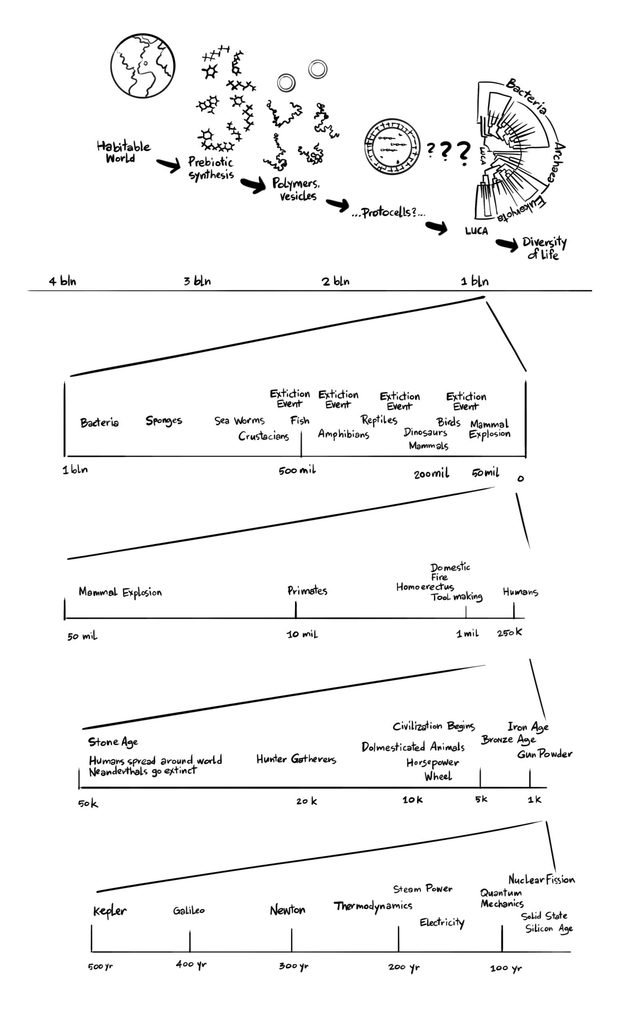
The accompanying diagram invites us to look at intelligence as part of a much larger story.
Intelligence did not begin with computers. Long before humans invented technology, living organisms were already responding to their environments, adapting to challenges, and developing increasingly complex ways to survive. Over millions of years, biological evolution produced nervous systems, brains, and eventually human intelligence.
Humans then developed something remarkable: the ability to share knowledge across generations through language, culture, education, and technology—forming a shared “cultural cloud” of collective memory. Instead of relying only on slow biological evolution, we began improving our capabilities through inventions.
Now, artificial intelligence represents another potentially significant development in this story.
The central idea is simple: intelligence can develop, change, and take new forms. However, this does not mean machine intelligence must develop exactly as biological intelligence did. The diagram offers a way to explore possible structural parallels between biological brains and information flow systems—not proof that every stage of future development is inevitable.
Why Do So Many People Misunderstand AI?
One of the biggest mistakes people make is assuming that artificial intelligence thinks the exact same way a human being does.
When an AI chatbot produces a thoughtful response, it can feel as though we are communicating with another person. But generating intelligent-sounding language is not the same thing as possessing human understanding, emotions, or consciousness.
Modern AI systems learn patterns from enormous amounts of data. These patterns allow them to produce useful answers, recognize images, and perform tasks that once required human expertise. That is impressive—but computational pattern-matching is not the same thing as self-awareness.
Another misunderstanding comes from treating AI as either completely harmless or unquestionably dangerous. Neither extreme helps us understand what is actually happening. AI already offers meaningful opportunities in medicine, scientific research, education, and communication. At the same time, it raises serious questions about misinformation, employment, and human control. Understanding both possibilities is essential.
What Is the Technological Singularity?
The Technological Singularity is a proposed future turning point when technological progress becomes so rapid and transformative that predicting what happens next becomes extremely difficult.
One possible path involves artificial intelligence reaching or exceeding human capabilities across a broad range of intellectual tasks. Imagine a future AI system capable of helping design an even more advanced AI system. That improved system might accelerate further discoveries, leading to increasingly powerful technologies—a potential cycle sometimes called an intelligence explosion.
The most important word here is potential.
Scientists, researchers, and philosophers disagree about whether such an event will happen, how it might unfold, and what consequences it could bring. The Singularity is not an established prediction with a guaranteed date. It is a possibility worth examining carefully.
Why Our Understanding Matters
Consider how humanity responded to earlier technological revolutions. The printing press transformed the spread of knowledge. Electricity changed daily life. Computers and the Silicon Age reshaped business, science, and communities. Each major advancement created new opportunities while introducing challenges that societies had to learn to manage.
Artificial intelligence may bring changes that are similar—or potentially much greater.
Yet there is an important difference. Previous technologies largely extended our physical abilities or helped us store and calculate information. AI increasingly performs tasks associated with reasoning, creativity, and decision-making. That makes questions about human responsibility especially important:
- Who should control advanced AI systems?
- How can we evaluate their reliability?
- How do we ensure their benefits are widely shared?
These questions cannot be answered by technology alone. They require human judgment, ethical discussion, and broad public understanding.
The Future Is About More Than Machines
Perhaps the most important lesson from studying the history of intelligence is that the future is not just about what machines might become—it is also about what humanity chooses to become.
As artificial intelligence grows more capable, we may need to reconsider familiar ideas about work, education, creativity, and our place in the world. But uncertainty does not mean helplessness. We can learn how these technologies operate, question exaggerated claims, encourage responsible development, and participate in informed conversations about the future.
Most importantly, we can approach technological change with curiosity rather than fear. The goal is not simply to predict the Singularity; it is to understand the possibilities well enough to make wiser decisions today.
Continue Exploring the Singularity
If these ideas have sparked your curiosity, I invite you to explore them further in my book, How to Survive the Singularity. The book examines the evolution of intelligence, human biology, artificial intelligence, and the profound questions surrounding humanity’s technological future. You don’t need to be a computer scientist to begin exploring these ideas—you only need curiosity and a willingness to question what you think you know.
Discover How to Survive the Singularity by Dr. Norman P. Johnson, available on Amazon — Explore the Book Here (← Highlight this text in WordPress and paste your Amazon link!)