SCREEN & STAGE · SIX-PART ANIMATED HISTORICAL FANTASY
Kokopelli
An animated adventure written by Dr. Norman P. Johnson. Six episodes of approximately one hour.
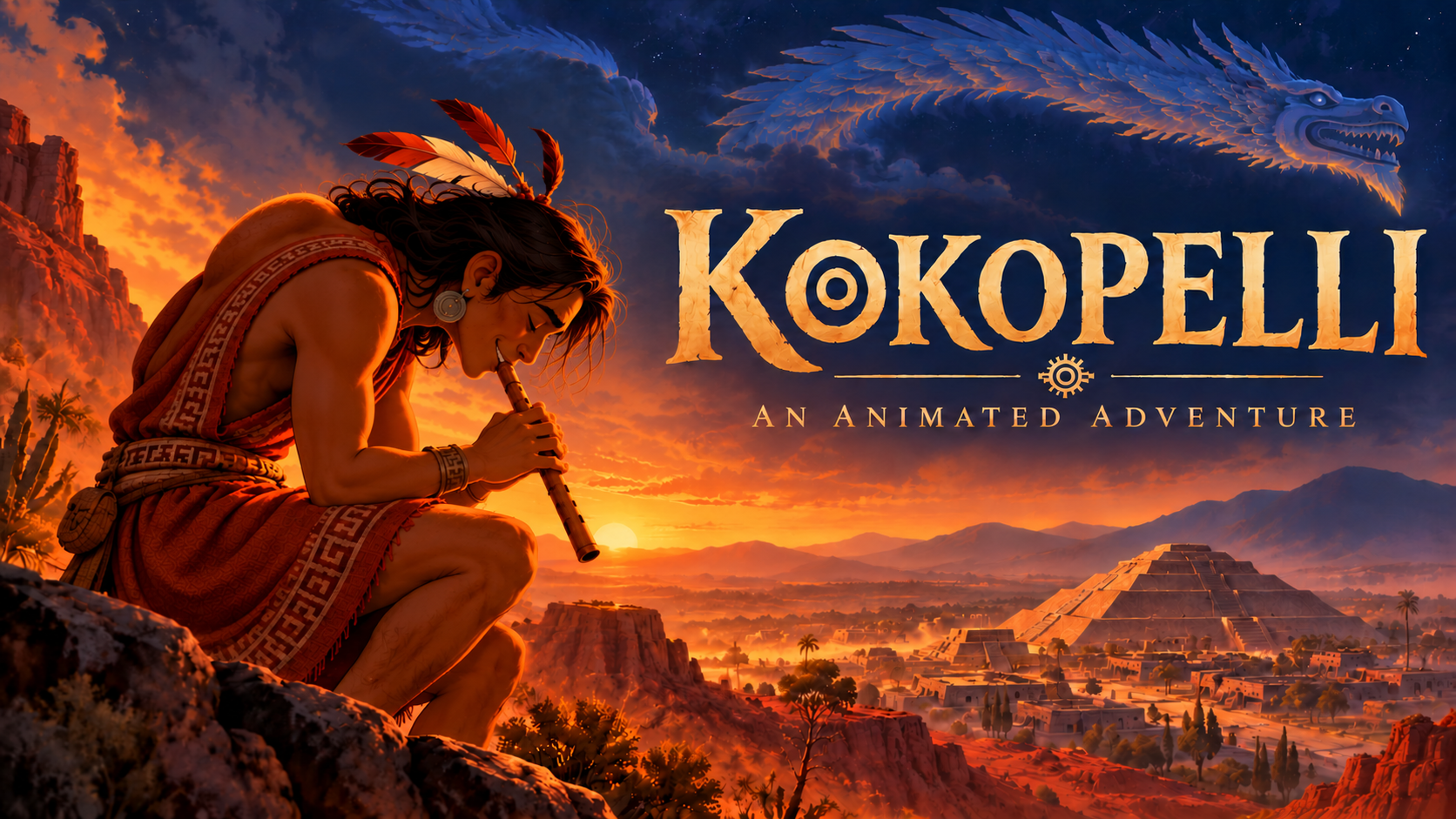
Hope in extraordinary times
In sixth-century Mesoamerica, a disabled young musician and his family of outcasts refuse to surrender to tyranny, using music and shapeshifting powers to rally ordinary people in a struggle to save their world.
Hope in extraordinary times
Kokopelli is an animated historical fantasy about hope in the face of adversity and perseverance in the face of opposition. Set in sixth-century Mesoamerica, it imagines a civilization whose prosperity conceals deep divisions. Priests turn belief into a weapon, addictive drugs make people easier to exploit, and rulers treat human lives as expendable. Its struggles over power, work and freedom echo our own times.
Hope becomes something people practice. A girl once enslaved defends another outcast. Old warriors find people worth protecting. A musician keeps playing when powerful men demand obedience. Ordinary people rise to the occasion, preserving their humanity and helping one another survive.
The story
Maimed in an attack at birth and hidden in the northern desert, Kokopelli grows up with a broken back, a restless spirit and a gift for music. Popo gives him a home and teaches him the Nagual, a spirit realm where humans can take animal form. Bebe, a girl freed from slavery, becomes his fiercely devoted adopted sister.
When danger draws Koko and Bebe from their refuge, aging warriors and persecuted young people join them. Koko’s music gives people a reason to gather; Bebe’s courage helps them stand together. His discovery that he is Teotihuacan’s rightful heir makes him a target for Coltal, a ruthless priest, and Xixi, his power-hungry half-sister.
Captivity and an escape through the underworld test the companions’ resolve. They persevere through fear and loss, returning to an occupied Teotihuacan where farmers, workers and former slaves help determine the city’s fate. As Xixi becomes an obsidian serpent, Koko answers as a flying feathered serpent. Rebellion becomes a firestorm. The city burns, but its people survive to choose new lives. The legend of the hunched flute player grows from their shared courage.
The series
Six animated episodes of approximately one hour follow a complete arc from exile to revolt. A painted visual world joins northern deserts, monumental cities and the Nagual. Music and irreverent humor sustain the adventure through its darkest passages. Koko’s appetite for life, Bebe’s fierce independence and Popo’s care make their unlikely family worth fighting for.
The central promise is that people can endure terrible times without surrendering their capacity for joy, love or action. Their victories cost them dearly. Still, they keep going, and their refusal to abandon one another gives humanity a future.
Watch the concept trailer
A concept presentation for a proposed animated series in development—not footage from completed episodes.
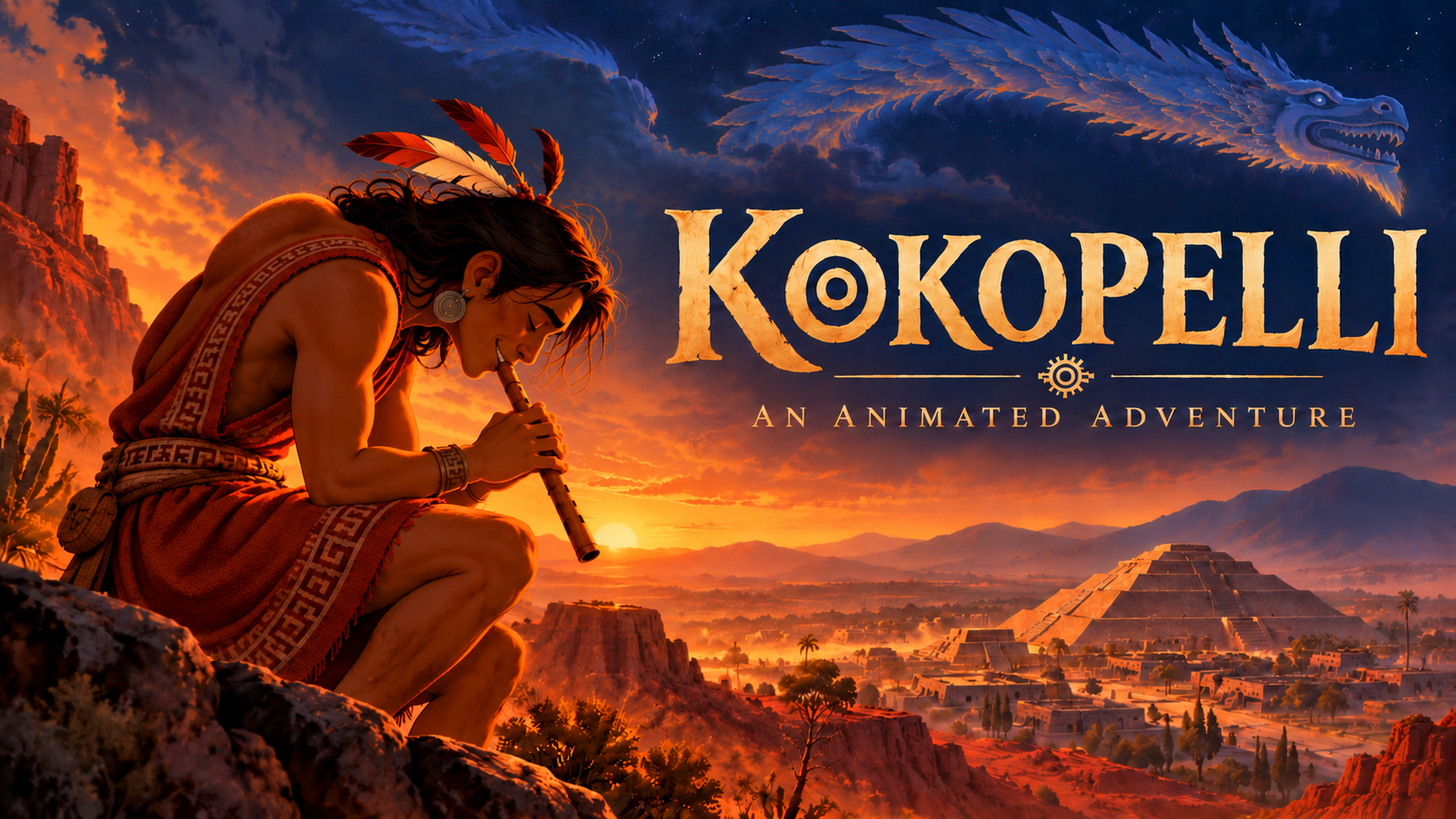
Six episode overview
Across exile, captivity and revolt, hope becomes a shared practice: people keep helping one another despite loss, fear and overwhelming opposition.
Episode 1 — The Broken Prince
A royal infant survives an attempt on his life that leaves him permanently disabled, while his mother is carried away to Tikal. Hidden in the northern desert, Koko grows up with Popo’s love, a gift for music and access to the Nagual, where humans take animal form. When Popo frees Bebe from slavery, the two young outcasts become an adopted family. Koko’s music draws people to their isolated home, and Bebe discovers the responsibilities of freedom. Beyond their refuge, Coltal and Tikal’s rulers expand a trade in addictive slave stimulants. Popo’s father, the Regent Xlangl, investigates the threat, only to die in a wayward robbery after surviving Coltal’s attack. His loss leaves the family’s protection dangerously weakened.
Closing hook Popo’s is attacked in her desert home by Coltal unexpectedly using the Nagual to become a monstrous raven.
Episode 2 — The Road From Chaco
Coltal attacks Popo and burns her home, forcing the family apart. Popo returns to defend Teotihuacan while Koko and Bebe travel south with her much needed medicines. In Chaco, his music and her singing earn a welcome, but their rescue of the chief’s daughter ends in tragedy when her father fulfills his sacrificial vow. Bebe refuses to let that failure justify abandoning others. Veteran warriors Krux and Ploxi join them, followed by Susu, a disguised female warrior rescued from priestly captivity. Their growing family encounters a mining settlement where drugged slaves sustain the evil lord’s wealth. While Susu and Ploxi confront the guards at the slave quarters, the others accept an invitation to a lavish feast, unaware that their host has recognized the wanted travelers.
Closing hook As Susu and Ploxi free the slaves, hidden warriors surround the feast and the Mining Lord reaches for his signal cord.
Episode 3 — The Thrower and the Song
The feast becomes an ambush. Koko plays because music is the only defense he has, and his song helps ignite a slave uprising. Freedom comes with costs he cannot dismiss; he begins to understand the responsibility that accompanies his influence. As the travelers continue toward Teotihuacan, farmers shelter them from pursuing priests, showing how ordinary people sustain resistance. At the coast, Popo helps dwarf defenders hold a palace with an ingenious thrower and discovers how the priests are bringing in massive drugs for controlling slaves replacing workers. Returning to court, she finds the Five Nations seduced by profits from the new drugged slave labor. In the capital, Susu’s defense of a mistreated slave draws the companions into a fight that exposes Koko to capture by Coltal.
Closing hook Coltal abducts Koko in a fast palanquin. His companions find only his pack and flute as warrior-priests close around them.
Episode 4 — The Captive Prince
Bebe becomes a hummingbird and tracks Koko’s abductors. A desperate palanquin pursuit nearly catches Coltal, but poisoned relay teams and a fortified border defeat the rescuers. Refusing to turn back, Bebe, Krux, Ploxi and Susu enter Tikal through the jungle. They find children hiding from the priests and train the older youths to enter a royal ball tournament as a disguised rescue force. Bebe grows into a leader who must weigh her brother’s life against the lives of her volunteers. In captivity, Koko discovers his mother, Juju, who gives him a flute; its music reassures his friends that he is alive. Their improvised team reaches the court, ready to turn a brutal spectacle into an escape but are discovered.
Closing hook Coltal recognizes the disguised rebels sounding the alarm. Warrior-priests advance from both ends of the court, as a spear flies toward Krux.
Episode 5 — The Land of the Dead
The trapped rebels seize the royal balcony, free Koko and Juju, and take Nxmul prisoner. Bebe expands the rescue to include the palace captives, while Juju recognizes Krux as her lost lover and Koko’s father. Pursued by Xixi, the companions escape into flooded passages and the underworld, where false voices exploit their longing and turn fear into mistrust. Koko and Bebe hold the group together through rhythm, shared medicine and a collective leap of faith: he becomes a flying feathered serpent, carrying the others while her hummingbird distracts the monsters. Nxmul refuses their help and is consumed by the beings he worships. The survivors reach daylight, but Xixi claims Tikal’s throne and prepares an invasion. Meanwhile drug dealers plot an assignation of the Supreme Lord with extremist priests.
Closing hook In Teotihuacan, assassins disguised as royal guards seize Arax. A knife rises while Popo and Spider Lady are held at bay.
Episode 6 — The Fall of Teotihuacan
A dwarf warrior’s audacious flight from the thrower helps foil the assassination, but Xixi’s army enters Teotihuacan. Koko and his companions return to a city divided by occupation and exploitation. His music reaches beyond the barricades, giving exhausted people hope; his capture and impending sacrifice test whether that hope can survive without him. Bebe and Popo intervene, and Koko rises as a Flying Serpent Eagle to confront Xixi’s obsidian Feathered Serpent form. Farmers march on the city, targeting the institutions that stole their future. Their fires spread beyond control, and mutual survival draws former enemies together. Superheated by the blaze, Xixi strikes the palace pond where defenseless survivors huddle and shatters on impact. The survivors build new lives through healing, partnership and service. Years later, Bebe carves Koko’s image as he plays.
Resolution The city is lost, but its people endure. The final flute melody carries hope beyond the ruins and into legend.
Meet the characters
An adopted family of outcasts carries the adventure. Music, humor, love and the choice to protect others give them the courage to continue.
Kokopelli (Koko)
Maimed at birth and raised in the northern desert, Koko has a broken back, a restless spirit and a gift for music. Popo gives him a home; Bebe becomes his adopted sister and closest companion. His music gathers people who have little reason to trust one another, while his discovery that he is Teotihuacan’s rightful heir makes him a political target. The violence surrounding the mine revolt forces him to reckon with the consequences of his influence. Captivity and the underworld deepen his reliance on others. His final transformation into the Flying Serpent Eagle gives spectacular form to a courage already expressed in his refusal to stop playing. The legend survives through the people who keep his image and stories alive.
Bebe
Freed from slavery by Popo, Bebe defends Koko before either understands the dangers ahead. A powerful singer and fierce fighter, she treasures her freedom and insists that others deserve it too. The tragic outcome of the Chaco rescue tests that conviction without extinguishing it. When Koko is abducted, she tracks him as a hummingbird and helps lead an improvised rescue force, taking responsibility for leading frightened young volunteers. She takes risks freeing captives beyond her own family. Her courage and cleverness hold the companions together through the underworld and the city’s fall. In the final image, she carves the iconic flute player as witness to the story they lived for all future generations.
Popo
Koko’s adoptive mother is a healer and a formidable shapeshifter who teaches him the Nagual. Her remote home offers love and freedom beyond the court’s reach, until Coltal destroys that refuge. The loss of her father, Xlangl, draws her back into a political world compromised by corrupt religion and the profits of drugged slave labor. She must extend the care she gives her household to people threatened across the Five Nations. Her hawk and jaguar forms make her a dangerous defender, but healing remains central to her purpose. Her eventual reconciliation with Spider Lady connects her own fractured family to the new household that forms after the city’s burning.
Krux and Juju
Krux is an aging warrior whose skills find renewed purpose among Koko’s companions. He pursues the abductors, trains young rebels for the ball tournament and risks himself in the rescue. Juju, Koko’s mother, has endured captivity in Tikal since the attack at his birth. Finding her son, she gives him a flute that restores his connection with the world beyond his prison. Their escape reunites her with Krux, her lost lover and Koko’s father. The reunion gives the wandering warrior and captive mother the family they believed lost. Both endure the return to Teotihuacan reigniting the love affair that started it all.
Ploxi and Susu
Ploxi is an experienced warrior whose partnership with Krux draws him into the travelers’ dangerous loyalties. Susu is a persecuted female from an extreme northern forest tribe. She becomes a self-taught warrior disguised as a man. She is rescued from priestly captivity, guarded in her trust and quick to confront human abuse. She has a personal secret that prevents her from having normal relationships. Her defense of a mistreated slave in Teotihuacan exposes the companions to fresh danger. She forms an uneasy competitive relationship with Ploxi and together, they carry much of the physical risk of fighting evil priests, freeing captives and protecting the group. Their sparring develops into affection and lasting partnership. Through them, the series gives seasoned fighters a future shaped by companionship and the choice of whom to defend.
Spider Lady
A healer who chose a life beyond royal obligations, Spider Lady is Arax’s older sister and Popo’s mother. She gave Popo to Xlangl, her father, to raise in the palace, leaving a wound that must find heeling. She is present at Koko’s birth and resists the attack that threatens her family. Her drugs and medicinal knowledge remain vital to the family’s survival. As the court collapses, her relationship with Popo brings the cost of old choices into the present, where respect and reconciliation become possible.
Arax and Xlangl
Arax, Teotihuacan’s Supreme Lord and Koko’s grandfather, embodies a royal order increasingly unable to function as head of state. Lives of pure luxury and pleasures is no training ground for leaders. Necessity drives the use of an exceptional man found stranded on their shores. Xlangl, becomes the Regent, falls in love with Spider Lady, has Popo, but Spider Lady cannot live as a royal so Popo is raised by her father and eventually sent to the northern deserts to seek out the rare Nagual medicines for use in his discovery of shape shifting. While investigating the expanding stimulant trade, he survives Coltal’s attack but dies in a chance robbery, an abrupt loss that leaves Popo grieving and the royal family exposed. Their stories measure the fragility of institutions against the more durable obligations people choose toward one another.
Xixi
Koko’s half sister is shaped by Tikal’s violent royal and priestly world. She is inspired by her insane father who kidnapped and raped her mother and is trained in the Nagual by Coltal. She pursues power through terror, claims the throne by heredity and brings an invading army to Teotihuacan to enforce it. Her obsidian Feathered Serpent form turns that ambition into an overwhelming threat. She pursues the companions and is later confronted by Koko above a city already consumed by rebellion and fire. As the defenders seek refuge from the firestorm, Xixi as the obsidian feathered serpent becomes superheated by the blaze, she strikes the palace pond where survivors shelter and shatters her glass body into splinters. Her destruction ends the immediate threat, but the city is gone and the survivors still face the work of building lives elsewhere.
Coltal
A ruthless ballplayer and later evil priest and Nagual shapeshifter, Coltal conspires to destroy the Supreme Lord and take over the corrupt royalty for his master, the king of Tikal, Nxmul. He is responsible for revealing Koko’s birth place and the kidnapping of his mother. He helps raise Xixi in the dark arts, steers the drug lords to undermine the economy, and attacks Xlangl in a bid to control the Nagual in Teotihuacan. He finds Popo, destroys her home and later when the companions enter Teotihuacan, he abducts Koko to Tikal for sacrifice. He recognizes the disguised rescuers at the Tikal tournament, turning their plan into a desperate fight to escape. His use of the Nagual makes him a recurring aerial adversary for Popo, Bebe and Koko. In the final battle, the wounded and fire ravaged raven falls into the river; his body is unseen and his fate remains open.
Nxmul
The ball playing prince whose attack maims the newborn Koko also carries Juju into captivity. Years later, with Koko as his prisoner, the rescuers take him prisoner along with rescuing Koko and his mother, Juju, and bring him into the underworld. There, survival depends on accepting help and trusting the companions he has harmed. He refuses the shared medicine and is consumed by the beings he worships. His end brings the family’s earliest antagonist to the point where even their offered help cannot save him.
Inside the illustrated world
Explore the original Kokopelli lookbook, along with concept illustrations of architecture, trading life and a traditional ballgame.
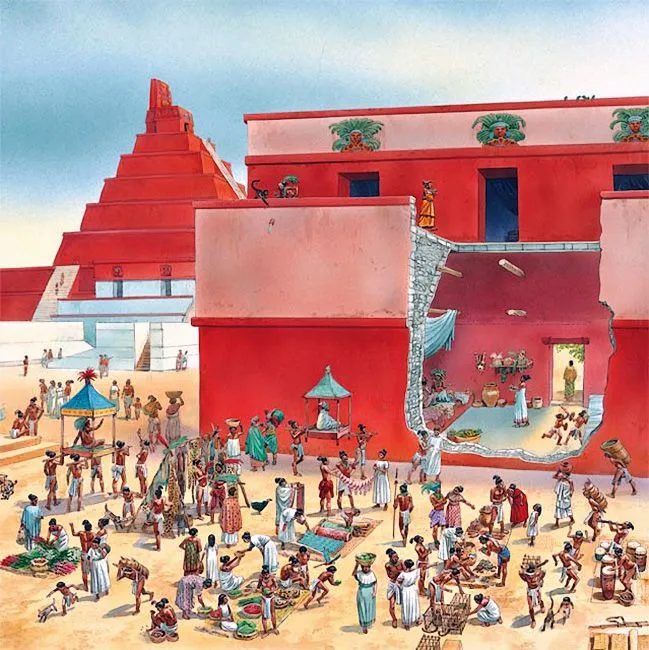
Ancient architecture
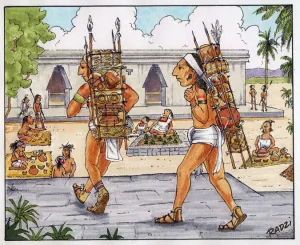
Everyday life and trade
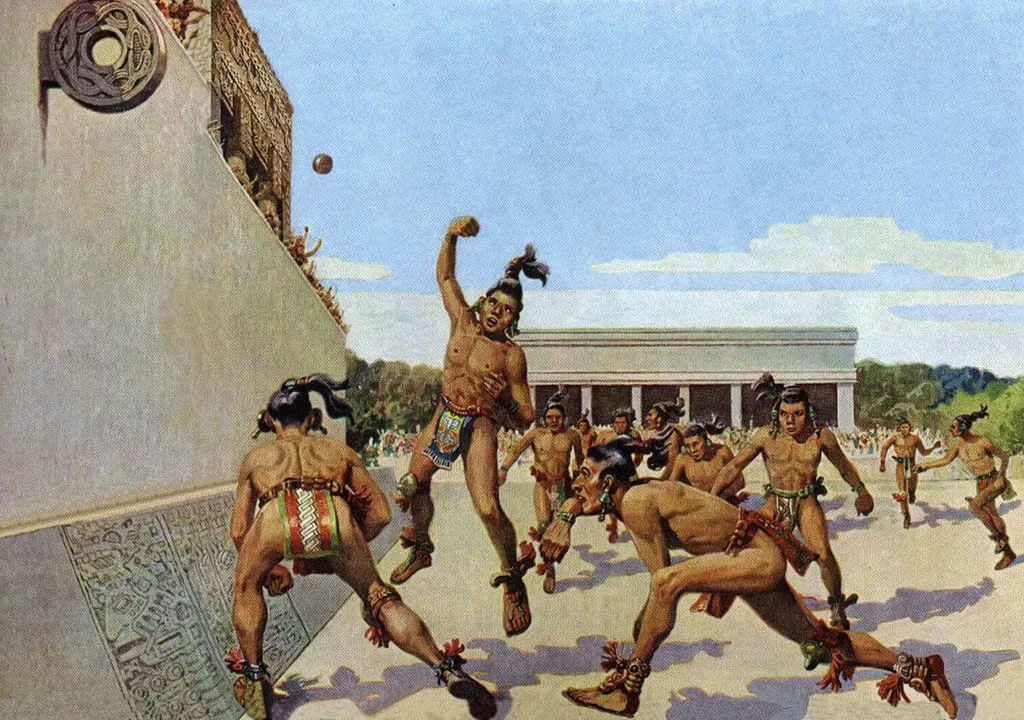
Traditional ballgame
Pilot screenplay and pitch materials
Episode 1: The Broken Prince — pilot screenplay and producer-facing pitch materials for the proposed series.